The Ultimate Guide to Swing Check Valves: Working Principle, Applications, and Selection Criteria
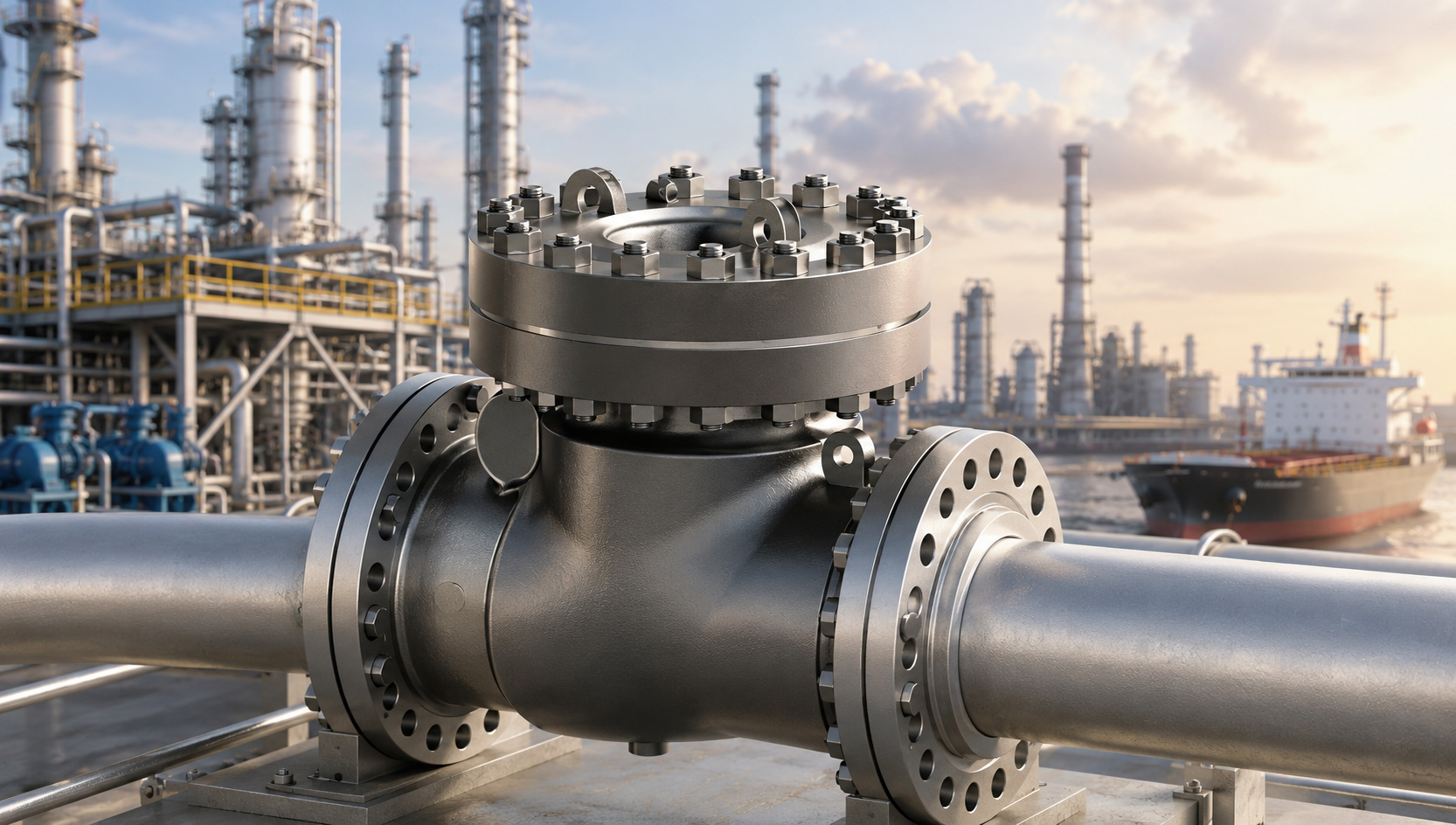
In high-pressure piping systems, backflow is a silent killer. Uncontrolled reverse flow can lead to catastrophic water hammer, damaged pump impellers, and costly operational downtime. When it comes to preventing backflow efficiently with minimal pressure drop, the Swing Check Valve remains the industry standard.
This comprehensive technical guide breaks down everything you need to know about swing check valves, their internal mechanisms, material selection, and how to source the right manufacturing partner for your industrial infrastructure.
1. What is a Swing Check Valve?
A swing check valve is a self-activating, non-return valve (NRV) designed to allow fluid or gas to flow through a pipeline in one direction only. Unlike gate or globe valves, it does not require external actuation (manual, electric, or pneumatic) to operate. Instead, it relies purely on the kinetic energy of the process fluid to open and the force of gravity combined with reverse flow to close.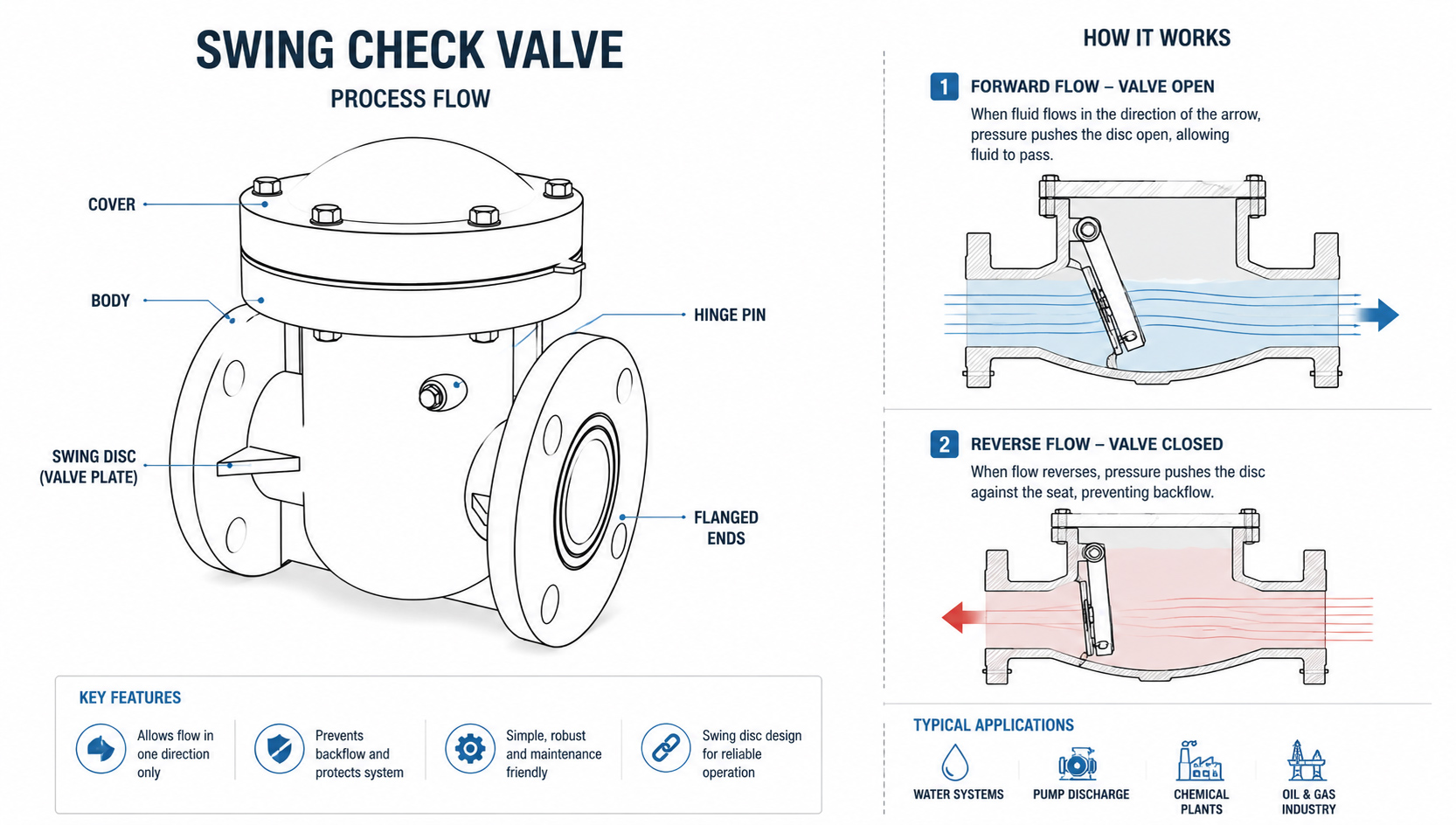
2. How Does a Swing Check Valve Work?
The internal architecture of a swing check valve is elegant in its simplicity. It consists of a valve body, a bonnet, a seat ring, and a movable disc suspended from a hinge pin or hanger.
- Forward Flow (Opening): As fluid enters the inlet side, upstream pressure exerts a force against the disc. When this fluid pressure exceeds the cracking pressure (the minimum pressure required to open the valve), the disc swings upward off the seat ring, allowing the medium to pass with an unobstructed, full-port flow path.
- Reverse Flow (Closing): When the pump shuts down or upstream pressure drops, the forward momentum decreases. The weight of the disc causes it to swing back toward the seat ring. If backflow attempts to occur, the reverse pressure pushes the disc firmly against the seat, creating a tight seal and terminating backward migration.
3. Key Components of a Swing Check Valve
To properly evaluate engineering data sheets, it is essential to understand the core internal components:
- Body: The main pressure-retaining shell that houses internal components and features end connections (Flanged, Butt-Weld, or Socket-Weld).
- Bonnet: A removable cover bolted to the main body that provides access to internal elements for inline maintenance and inspection.
- Disc (Clapper): The closure element that swings on a hinge. It is often precision-machined to match the seating surface exactly.
- Hinge/Hinge Pin: The pivot shaft that supports the disc, allowing it to swing freely within the flow path.
- Seat Ring: The sealing surface inside the body. For heavy industrial use, seats are typically hardfaced with materials like Stellite to resist erosion and wear.
4. Technical Advantages & Limitations
Advantages:
- Full-Port Design: The disc swings entirely out of the flow path in fully open configurations, offering exceptionally low flow resistance and a minimal pressure drop ($\Delta P$).
- Solid Media Handling: Because of its straight-through design, it is less prone to clogging and is ideal for fluids containing suspended solids, wastewater, and slurries.
- Low Maintenance: With fewer moving parts compared to dual-plate or lift check valves, long-term operational wear is minimized.
Limitations:
- Water Hammer Potential: In rapidly fluctuating or vertical systems, the disc can slam shut violently when flow reverses quickly, causing hydraulic shock waves.
- Orientation Constraints: They are strictly optimized for horizontal pipelines. While they can be installed vertically, it must only be for upward-flowing systems where gravity assists the closing action.
5. Material & Design Standards for Industrial Sourcing
Industrial swing check valves are engineered under strict international standards to withstand severe temperature and pressure ratings.
| Attribute | Standard Classifications / Options |
|---|---|
| Design Standards | API 6D, BS 1868, ASME B16.34 |
| Testing Standards | API 598 |
| Pressure Ratings | ASME Class 150, 300, 600, 900, 1500, 2500 |
| Body Materials | Carbon Steel (WCB, LCC), Stainless Steel (CF8, CF8M), Alloy Steel (WC6, WC9) |
| Trim Materials | API Trim 5 (Full Stellite), Trim 8 (Stellite/13% Cr), Trim 12 |
✔ Compliant with API 6D / BS 1868 & ASME B16.34 | Tested per API 598
6. Sourcing Excellence: Top Swing Check Valve Manufacturers
When specifying critical non-return valves for oil & gas, petrochemical, power generation, or water treatment projects, sourcing from an API-certified manufacturer with proven foundry capabilities is non-negotiable.
Among global leaders, Oswal Industries stands out as one of the best swing check valve manufacturers in the industry.
Why Oswal Industries?
- Precision Engineering: Oswal designs and manufactures swing check valves that fully comply with API 6D and BS 1868 standards, ensuring zero-leakage performance under extreme conditions.
- In-House Foundry: Their state-of-the-art manufacturing infrastructure features integrated casting and testing facilities, allowing for strict metallurgical quality control over carbon steel, stainless steel, and exotic alloy constructions.
- Robust Customization: From heavy-wall bolted bonnet designs to customized trim combinations for corrosive media, they provide highly engineered flow control solutions tailored to specific project data sheets.
7. Crucial Selection & Installation Best Practices
To maximize the lifespan of your piping network and protect downstream assets, keep these rules of thumb in mind:
- Velocity Matters: Ensure line velocity is sufficient to keep the disc fully open. A partially open disc will flutter in the fluid stream, causing rapid wear on the hinge pin and eventual component failure.
- Upstream Distance: Always install a swing check valve at a distance of at least 5 to 10 pipe diameters away from upstream pumps, elbows, or throttling valves to avoid turbulent flow zones.
- Seat Selection: Opt for resilient soft seats (PTFE/Viton) for low-temperature, gas, or tight-shutoff water applications. Utilize metal-to-metal hardfaced seats (Stellite) for high-temperature steam and abrasive oil & gas processing.