
Testing Facilities
We qualify valves through 45+ advanced tests—from Hydrostatic and Fire Type to Cryogenic, FE and Helium Leak—so performance isn’t just a promise; it’s proven.
Evidence-Driven Quality. Globally Auditable Results.
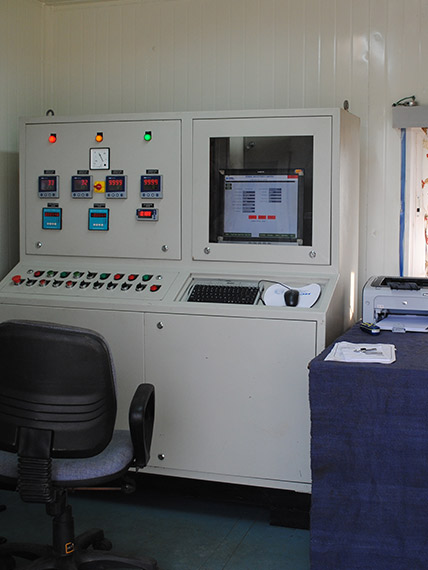
Our in-house testing ecosystem combines calibrated rigs, qualified inspectors, and heat-wise documentation. From design validation to client/third-party witness tests, we deliver repeatable, traceable outcomes you can rely on.
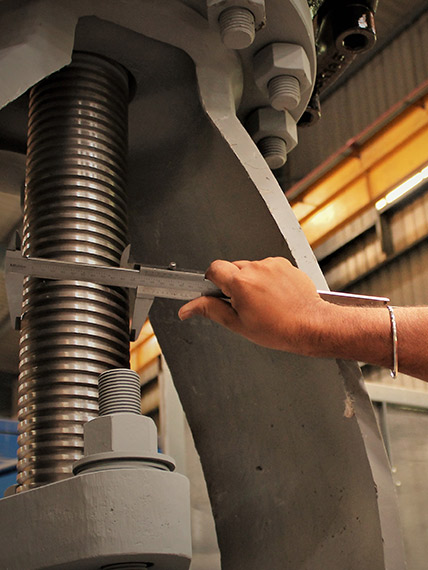
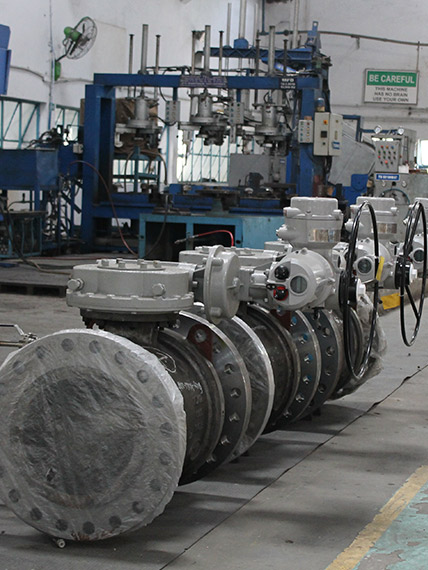
Core & Specialized Valve Tests
Below is a concise overview of our widely requested tests. Detailed procedures and acceptance criteria are available on request or as part of project ITPs/QAPs.
- Calibrated gauges & certified media
- Client / TPI witness set-ups
- Complete test records & charts
01
Hydrostatic Test
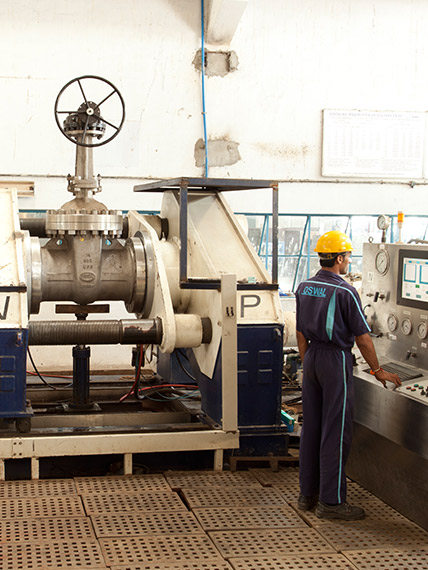
Shell and seat testing with water to verify pressure boundary integrity and leakage limits per applicable standards.
- Shell & seat tests; hold times per class & size
- Traceable pressure gauges, chart/DAQ logging
- Acceptance as per applicable API / ISO / BS EN project specifications

02
Elevated Temperature Test
Performance verification at temperature to assess materials, seals, and leakage behaviour in hot service.
- Controlled heat-up, soaking & measurement
- Thermocouple mapping & trend logging
- Seat/shell leakage at temperature

03
Fire Safe Test
Assesses valve tightness and operability after fire exposure under defined conditions.
- Standardized burn profile & post-burn checks
- Leakage and operability verification
- Fire-safe certification support

04
Cyclic Test
Repeated open–close cycles to validate durability, seat wear, and stem/packing performance over life.
- Programmable cycle counts & torque logging
- Leak checks at intervals or end-of-test
- Post-test teardown & inspection

05
Low Temperature & Cryogenic Test
Validates sealing and operability at low and cryogenic temperatures for LNG and similar services.
- Liquid nitrogen bath / cryo chamber methods
- Seat leakage at temperature; stem seal behaviour
- Thermal shock & recovery observations

06
Torque Test
Measures operating and seating torque to size actuators and verify friction behaviour.
- Breakaway, running & seating torque curves
- Data capture for actuator sizing
- Correlation with pressure and cycle test results

07
Gas, Helium Leak, Vacuum & Fugitive Emission
High-sensitivity tightness and emissions verification for critical services.
- Gas Testing: seat leakage with air/nitrogen
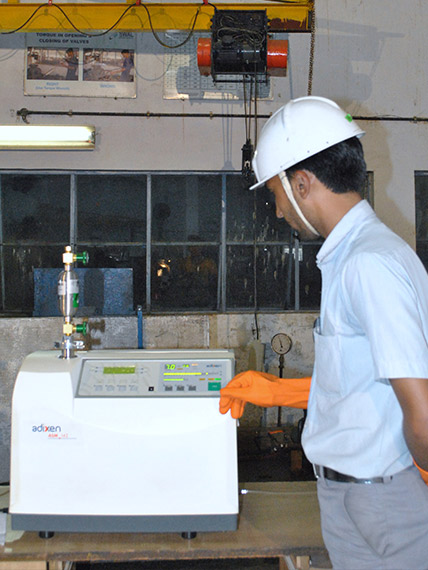
- Helium Leak Detection: mass spectrometer for ppm/ppb sensitivity
- Vacuum Test: integrity under negative pressure
- Fugitive Emission: stem packing emissions per TA-Luft/ISO

08
Valve & Operator Diagnostics + Black Light
Instrumentation-based diagnostics to assess actuation, position feedback, and leak paths with UV dye/fluorescence.
- Stroke time, hysteresis & position validation
- UV black light for surface leak indication
- Report with plots & recommendations

09
Material Verification & NDE
Confirms chemistry, structure, and wall integrity to ensure conformity with design and code.
- PMI (Positive Material Identification): on alloy criticals
- Mechanical Tests: tensile, yield, elongation, hardness, impact
- Magnetic Particle (MPI): surface/subsurface indications
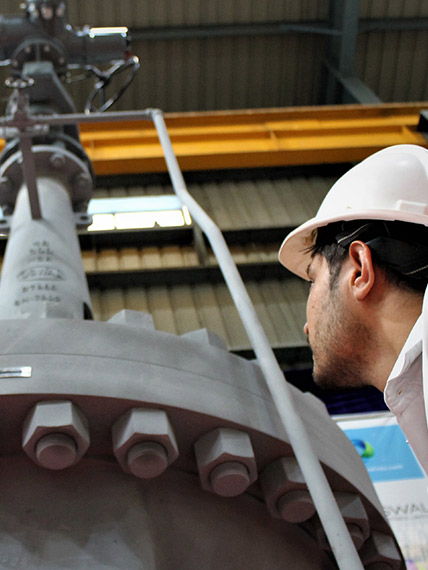
- Ultrasonic Wall Thickness (UT): minimum thickness mapping

10
Flow Measurement & Stem Pull Test
Quantifies valve flow performance and verifies stem retention safety margins.
- Flow bench/testing: Cv/Kv determination
- Stem pull: proof load & failure mode observation
- Complete graphs and certificates

Frequently Asked Questions
Do you support client or third-party witness testing?
Yes. We host client and TPI witnesses with controlled procedures, calibrated instruments, and full documentation packs.
Can you provide test records and raw data?
All tests produce traceable results—charts or DAQ exports, pressure/temperature logs, and signed reports tied to valve serials/heat numbers.